Establishing Enterprise Governance for Technology Upgrades: A Standardized Approach to Cost Reduction and Operational Efficiency
Overview
The Business Challenge
The business challenges are visible to see again!
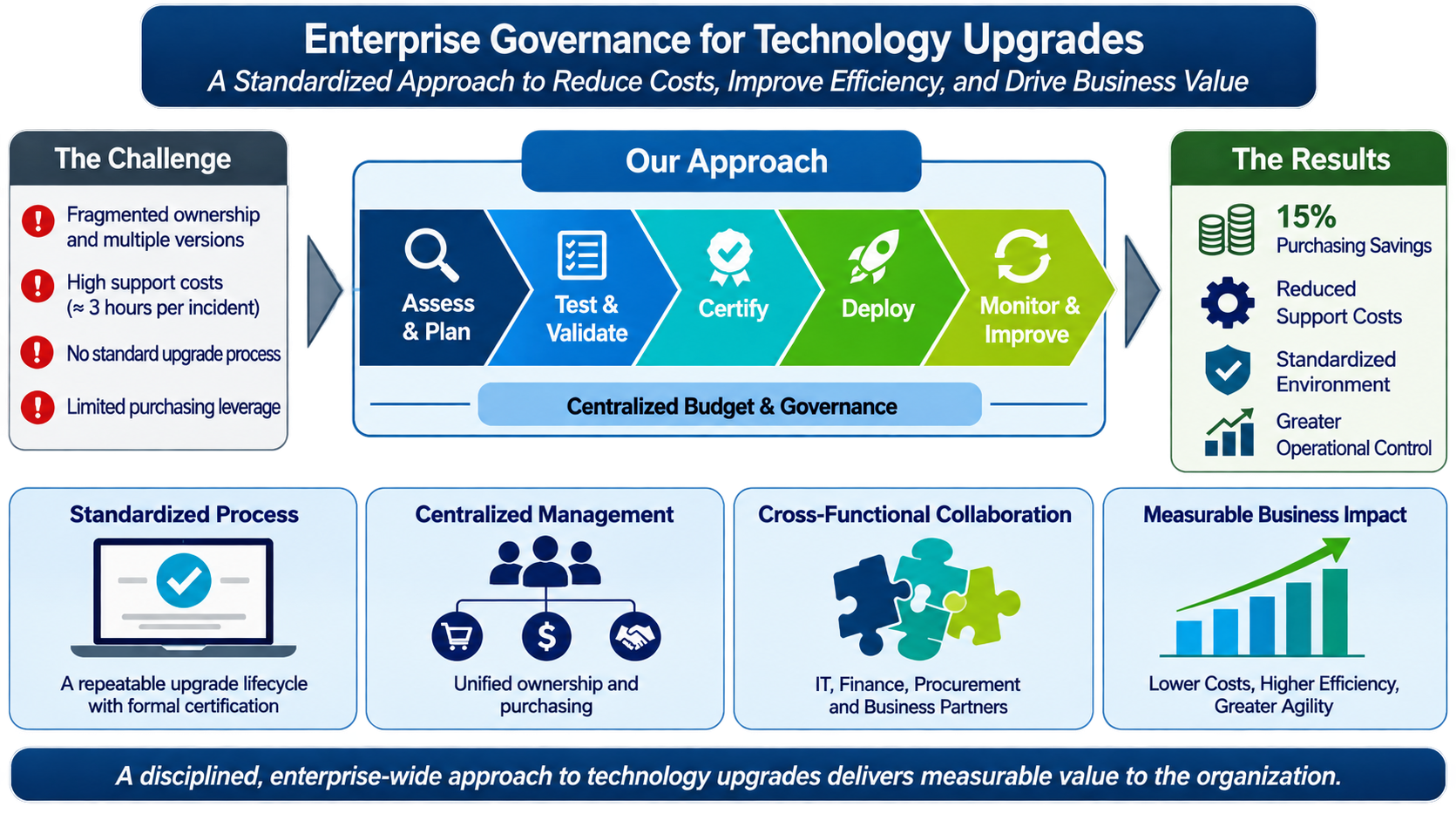
Managing desktop technology across a large organization had become increasingly complex, costly, and inefficient. With an environment supporting approximately 3,000 desktop applications, the organization lacked a consistent process for evaluating, testing, approving, and deploying software upgrades. The consequences extended well beyond the technology department. Infrastructure management estimated that each desktop incident required an average of three hours to resolve. The resulting support burden consumed significant resources that could otherwise have been directed toward strategic initiatives, including technology standardization, security, and infrastructure improvements.
Compounding the problem was the decentralized ownership of desktop software. Individual departments independently purchased and maintained products, often without sufficient coordination with the teams responsible for supporting them. This fragmented approach created multiple versions of the same applications across the enterprise, increased support complexity, contributed to user downtime, and prevented the organization from taking advantage of purchasing economies of scale.
The organization needed more than an improved technical upgrade procedure. It needed an enterprise-wide management framework that established accountability, standardized decision-making, improved operational control, and reduced the overall cost of technology ownership.
The Strategic Opportunity
The objective was to establish a standardized, repeatable process for managing desktop technology upgrades across the enterprise.
Given the scale and complexity of the application environment, a successful approach required more than simply deploying new software. Each upgrade needed to be evaluated in the context of the broader technology environment, including product compatibility, integration requirements, support capabilities, business impacts, and organizational readiness.
A second, equally important objective was to centralize ownership and financial accountability for desktop software. Moving purchasing and maintenance responsibilities into a centrally managed function would allow the organization to establish consistent standards, coordinate upgrade schedules, manage expenditures against an overall budget, and negotiate more favorable purchasing arrangements.
Together, these initiatives represented an opportunity to transform desktop technology management from a decentralized, largely reactive support function into a coordinated enterprise capability.
The Approach: Establishing a Governed Upgrade Lifecycle
I developed and implemented a standardized technology upgrade process that incorporated the discipline of a traditional waterfall Software Development Life Cycle (SDLC), adapted to the specific requirements of desktop products and their enterprise-wide deployment.
The process established a structured lifecycle for evaluating, testing, certifying, and deploying technology upgrades.
A central feature was the introduction of a formal product certification requirement before deployment. Certification served as management's approval that the necessary unit, integration, and user acceptance testing had been completed and that the team understood the operational and organizational implications of the upgrade.
This established a clear accountability point: products could not proceed to deployment simply because a technical upgrade was available. They first had to demonstrate that they were ready for use within the organization's broader technology environment.
Rather than introducing the process across the entire organization at once, I initially applied it to lower-risk upgrades in a controlled environment. This provided an opportunity to validate the methodology, identify weaknesses, and incorporate lessons learned before expanding its use.
I also established a matrix management structure to bring together the resources and expertise required from across the organization. Teams included infrastructure management, desktop support, technical specialists, product owners, and business user groups. This ensured that upgrade decisions reflected both technical requirements and the needs of the departments that depended on the products.
Each implementation contributed to improving the process. Results were evaluated to identify opportunities for refinement and to establish more effective performance criteria. Where issues required broader organizational attention or cross-functional decisions, I escalated them to management to secure the necessary support and maintain progress.
The result was a disciplined, repeatable process that combined technical controls with business participation, management accountability, and continuous improvement.
Centralizing Financial and Operational Accountability
Establishing a standardized upgrade process addressed the technical and operational challenges, but achieving lasting improvement also required changing how desktop software was purchased, maintained, and funded.
Historically, individual departments controlled their own software budgets and purchasing decisions. This made it difficult to coordinate upgrades, maintain consistent standards, or manage the organization's total software expenditures.
I worked with Desktop Support, Procurement, and Finance to establish a centralized budget structure for desktop software purchases and maintenance.
This required developing policies governing software licensing, maintenance agreements, and purchasing authority. The objective was to ensure that enterprise technology upgrades could be planned and executed without creating unexpected financial burdens for individual departmental cost centers.
Recognizing that centralization could be perceived as a loss of departmental control, I made stakeholder engagement an important part of the transition. Departments were given opportunities to participate in product certification and upgrade activities, preserving their involvement in decisions that affected their operations while moving financial and purchasing accountability into a central function.
Most departments supported the approach once the organizational benefits were understood. Where resistance remained, I worked directly with the affected groups and escalated unresolved issues when necessary.
Ultimately, Finance supported the initiative and established a dedicated cost center to manage desktop software purchases. This created a single point of financial accountability and enabled the organization to manage expenditures against an overall budget rather than through disconnected departmental spending.
Results: Improved Control, Reduced Costs, and Greater Operational Efficiency
The process was formally developed, published, and communicated to key members of Technology and Infrastructure Management. As implementation progressed, the framework supported a substantial volume of concurrent upgrade activity.
At one point, I was managing more than 23 upgrades simultaneously, with individual matrixed teams ranging from five to 25 members. The largest initiative, involving Cognos, included 35 participants from both IT and business organizations.
The organizational benefits were significant:
Reduced support complexity and operational costs. By requiring products to be tested and certified before deployment, the organization reduced implementation issues and associated support demands. Standardizing product versions also allowed desktop support teams to concentrate on a single version of each application rather than maintaining knowledge and troubleshooting procedures for multiple versions.
Greater technology standardization. The process helped establish a consistent application environment, eliminating multiple versions of the same product and reducing the complexity associated with supporting disparate configurations.
Improved financial management. Centralizing software purchasing and maintenance created greater visibility into expenditures, simplified administration, and enabled the organization to manage desktop software costs against an overall budget.
Realized purchasing economies of scale. Consolidating purchasing activity allowed the organization to negotiate bulk purchasing arrangements and achieve average savings of approximately 15%.
Stronger cross-functional collaboration and accountability. The matrix management approach brought technical teams, Finance, Procurement, and business stakeholders into a coordinated process. Departments retained a voice in product certification and upgrade decisions while benefiting from consistent enterprise-wide management.
Conclusion
This initiative demonstrated that managing technology upgrades effectively requires more than technical expertise and deployment discipline. It requires an integrated management approach that connects technology decisions to operational performance, financial accountability, and organizational priorities.
By establishing a standardized upgrade lifecycle, introducing formal product certification, engaging stakeholders across functional boundaries, and centralizing software purchasing and budget management, the organization moved away from fragmented technology management toward a more controlled and economically efficient operating model.
The broader lesson is that technology standardization and cost reduction are most effective when supported by clear governance, defined accountability, disciplined execution, and organizational alignment. The framework delivered those capabilities while allowing the business to maintain meaningful participation in the technology decisions affecting its operations.